

glossary of terms
4 Colour Process: The process of combining four basic colours to create a printed colour picture or colours composed from the basic four colours. Also referred to as CMYK.
Bar Code (see UPC): A graphical bar pattern which can encode numbers and letters in a format which can easily be retrieved and interpreted by a bar code reader.
Bitmap: In computer imaging, the electronic representation of a page, indicating the position of every possible spot (zero or one). Also called raster image, continuous tone, halftone.
Bleed: The extra amount of printed image that extends beyond the cut line.
Boost Black: Printing additional process inks under process black in order to darken the appearance of solid process black areas. Our standard Boost Black is 20% Cyan, 10% Magenta 10% Yellow and 100% Black.
CMYK: The acronym for the four process color inks: Cyan (Blue), Magenta (Red), Yellow and Black.
Colour Matching System: A system of formulated ink colours used for communicating colour. Print industry standard is the Pantone Numbering System.
CTP: Acronym for Computer To Plate. CTP technology involves the laser-imaging of printing plates. The laser is driven by electronic data from a computer.
Cut-back: Reducing the size of a printed area that will be printed underneath another colour. Typically used when printing white underneath another colour or colours.
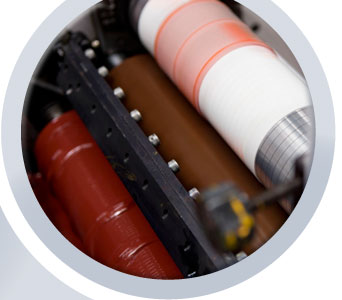
Cylinder: The printing rolls on which flexographic printing plates are mounted.
Cylinder Gap: The slight space between the plate edges where the plate meets when wrapped around a cylinder.
Die: Metal rule or imaged block used to cut or place an image on paper in the finishing process.
Dieline: A non-printing line that represents where the die will cut.
Distortion: In flexographic printing plates are scaled to correct for the stretch that comes from wrapping the plates around a cylinder.
Duotone: A raster image that prints with two seperate colours.
Eyemarks: A small rectangular printing area usually located near the edge of an image. Used to activate an automatic electronic position regulator for controlling register or the printed design with separate equipment or operations. Such as, foil stamping and steel rule dies.
Flood: To completely cover the printed area with ink or varnish or Ultra Violet protection.
Foil Stamping: Using a die to place a metallic or pigmented image on paper.
Font: The general style of text found on a layout. Broken in to many catergories including Script, Serif Sans Serif and Blackletter. Associated minimum point size is 4 pt type.
FTP: Acronym for for File Transfer Protocol. Enables large files to be transferred electronically from one location to another.
Gear Side: The side of the print run where the drive gears are located.
Gradient (also Vignette): A printed colour that slowly fades away or blends in to another colour.
Halftone: A printed value that is not 100% or 0% of a single ink colour.
Headers: The short lines of emphasized text that introduce detailed information in the body text that follows.
Hexachrome: A colour separation process developed by Pantone that uses six instead of four process colours. More accurate and capable in the greens and oranges.
Ink Strength: The 'darkness' of a printed ink, or combination of inks. Used when trapping a job and deciding on print order.
Kiss Cut: Used to describe two impressions that are cut with no spacing between the cut lines.
Kiss Die Cut: To cut the top layer of a pressure sensitive sheet and not the backing. All our labels are cut this way as a standard.
Kodak Approval (CMYK): a standard hi-resolution, digital proof that is made up of CMYK values only. The size of a proof is 18" x 12".
Kodak XP4: Same as a Kodak Approval but it's able to include Pantone Spot colours. The size of proof is approximately 20" x 25".
Laminate: To cover with film, to bond or glue one surface to another.
Leader Dots: A series of periods or dots connecting wo items of text that are set a distance apart. Typically used in a table of contents when the page number could be on the other side of the page.
Leading: (pronounced ledding) The amount of space added between lines of text. Most applications automatically apply standard leading based on the point size of the font.
Line Screen: A number used to express the fineness of a halftone screen. The number refers to the number of dots such a screen is capable of producing in a single row exactly one inch long.
Live Text: Text that can be edited and changed easily.
Monotone: An raster image that prints with only one ink colour.
Net Fit: Printing two or more colors that exactly meet without any provision for color overlap.
Outlined Text: Text that has been outlined in a vector drawing program such as Illustrator. The key difference is that it is NOT editable and does not require the font file to be submitted.
Overprinting: Double printing; printing over an area that already has been printed.
Pantone Matching System (PMS): A proprietary color system for choosing and matching specific spot colours.
Pica: A unit of measurement used in typography and layout design. Equal to 1/6th of an inch, a pica is equal to 12 points.
Plate Cylinder: The cylinder of a press on which the plate is mounted.
Point(s): a unit of measurement used in typography and layout design. There are 72 points to 1 inch.
Pre-Flight: the first action when receiving electronic files from clients. This process analyzes files to determine if they meet our standards with necessary fonts, colour information, images and size before we proceed in creating a proof.
Press Check: Customer approved pre-printed sample before the full print run.
Press Proof: An approved copy of the final artwork including colors and text to be printed and to be used as reference while printing.
Print Order: The order in which multiple ink colours will be printed.
Proof Stamp: The information area on an outgoing proof that coimmunicates important information to the customer. Such as, die size and print colours of the job. Also has legal disclaimers outlining final responsibility of approval.
Quiet Zone: the space on the sides of a UPC or Bar Code. Our standard minimum is 6mm. See figure 2.1
Raster (see Bitmap): An image recorded by specifying the color at each cell of a grid. An individual cell in the grid is called a pixel (short for "picture element"). Digital cameras and scanners produce raster image files.
Registration: The quality of alignment of the different coloured inks as they are applied to paper. If the inks can be seen to overlap improperly or to leave white gaps on the page, the printing is said to be "out of registration", "poor register" or "mis-registration").
Rep File: Short for 'step and repeat file.' Exclusively used in the Art Department, it is the electronic file in which the artwork is duplicated according to the specification of the job. Runbars, crosshairs, swatches and the title bar are also included in this file.
Roll Direction: The orientation in which the finished label comes off the roll. Exact specifications must be supplied when an order is placed to ensure trouble free application.
Run Bars: Helps registration of crosshairs which in flexographic press, accurately positions the printing of each color station in the direction of the web travel. Stabilizer Bar: Part of the rep file a 1/32 of an inch bar running between rows on a printing plate. Designed to help stabilize the plate while printing.
Steel Rule Die: A different style of cutting die. Steel Rule Dies are bent strips of metal mounted in wood as opposed to engraved metal cylinders. Also called flat bed die.
Spot colour: Single colours applied to printing when process colour is not necessary (i.e. one, two and three colour printing), or when process colours need to be augmented (i.e. a fluorescent pink headline or a metallic tint).
Swatches: Small square patches of each printing colour placed outside the runbar. Used by press operators to monitor ink density. Title Bar: On a printing plate and in the electronic file used to create the printing plate, the area that includes the docket number, colour information, inch reference and swatches.
Trapping: Overlapping printed areas of different coloured inks to avoid the base material showing through.
Tritone: A raster image that prints with three separate colours.
Truncated: To reduce the height of a bar code without affecting the horizontal size.
Turn bars: An arrangement of stationary bars on a flexographic press, which guide the web in such a manner that it is turned front to back, and will be printed on the reverse side by the printing units located subsequent to the turning bars.
UPC: Acronym for Universal Product Code. A bar code symbology generally used in point-of-sale applications. See figure 2.1
Vector: file is a mathematical description of an image rather than pixels. It is scalable to any size and will not lose any image quality. It is the generic name given to any graphic created in applications such as Adobe Illustrator or Corel Draw.
Vignette (also Gradient): A printed colour that slowly fades away or blends in to another colour.
X Die: A virtual die used to set up the rep file for a film job.